
Finding the right manufacturing partner can feel overwhelming — especially when precision and quality are non-negotiable. Whether you are sourcing parts for aerospace components or prototyping the next consumer product your business depends on, the stakes are simply too high to settle for mediocrity. So how does one cut through the noise and find truly dependable cnc machining in the US? Let’s break it down.
Why Reliability Matters More Than Price
Here’s something most buyers learn the hard way: the cheapest quote rarely delivers the best outcome. A supplier that underbids often compensates by cutting corners on tolerances, material verification, or turnaround consistency. The US machining industry is valued at over $40 billion annually, yet a surprisingly large number of buyers still select vendors based on cost alone — and regret it.
Reliability in cnc machining in the US translates directly to fewer rejected parts, lower rework costs, and more predictable lead times. When a production deadline slips because a vendor delivered out-of-spec components, the downstream financial impact can dwarf whatever savings were made at the quoting stage. Think about that for a second.
Check Certifications and Quality Management Systems
Before anything else, look at certifications. A shop that holds ISO 9001 certification has demonstrated a documented commitment to quality management processes. For defense or aerospace applications, AS9100 certification matters even more. Medical device manufacturers should look for ISO 13485-compliant shops.
These are not just badges on a website. They signal that the facility undergoes regular third-party audits, maintains traceability documentation, and operates with disciplined process controls. When evaluating cnc machining in US providers, always ask for copies of their current certificates and check the expiration dates.
Evaluate Equipment Capabilities and Technology Investment
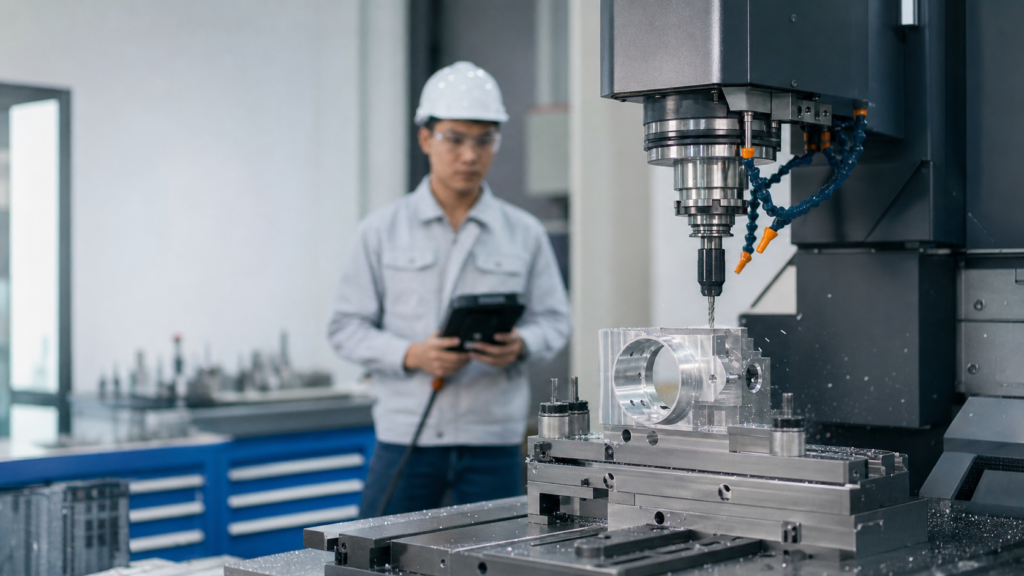
Not all CNC shops are created equal in terms of what they can actually manufacture. A shop running 10-year-old 3-axis mills may struggle to hold tight tolerances on complex geometries that a 5-axis machining center handles effortlessly. Does the provider invest in modern equipment? Are they running live tooling lathes, Swiss-type automatics, or multi-pallet horizontal machining centers?
For example: if your part requires simultaneous 5-axis contouring with a positional tolerance of ±0.001 inches, a shop without the corresponding hardware simply cannot deliver — regardless of how skilled their programmers are. Technology investment is a reliable indicator of a shop’s long-term competitiveness and their seriousness about precision work.
Inspect Their Material Sourcing and Traceability Practices
Sourcing material from certified US mills or reputable distributors matters enormously in regulated industries. Ask potential cnc machining in US vendors directly: Where does your raw material come from? Can you provide mill certifications with every shipment? Do you maintain a first-in-first-out inventory system?
Shops with strong traceability practices can trace every finished part back to a specific material heat lot. This may seem like an administrative detail until a quality issue surfaces — at which point that documentation can prevent a full product recall.
Review Their In-House Inspection Capabilities
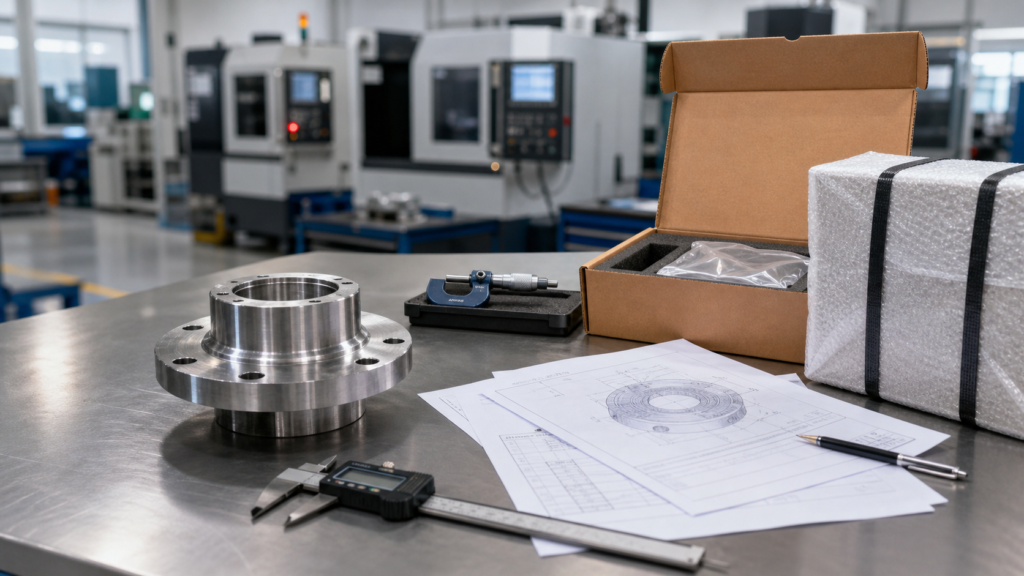
Precision machining without precision measurement is just machining. A trustworthy shop will maintain in-house CMM (Coordinate Measuring Machine) capability, optical comparators, surface roughness testers, and hardness testing equipment. Some advanced facilities even offer real-time SPC (Statistical Process Control) data on critical dimensions.
Ask to see a sample inspection report. Does it document all critical dimensions from the drawing? Is it clearly traceable to a specific job number? The quality of that documentation tells you a great deal about a shop’s operational discipline.
Look at Industry Experience and Part Complexity
General job shops serve a purpose but vertical specialization creates a measurable advantage. A facility that has machined thousands of hydraulic valve bodies understands the specific challenges — thin walls, deep bores, precise surface finishes — in a way a generalist shop simply cannot replicate. When searching for cnc machining in US partners, look for demonstrated experience in your specific industry or part family.
Ask for references. Ask to see sample parts or case studies. A confident supplier will share that information readily.
Assess Communication and Responsiveness
This one is underrated. How quickly does a shop respond to RFQs? Are their quotes detailed and itemized or vague one-liners? Do they ask clarifying questions about your drawing before quoting — which signals they are actually reading it?
Responsiveness during the sales process is a reliable preview of how they will handle issues mid-production. A shop that takes two weeks to return a quote will likely take just as long to respond to a non-conformance report.
Domestic Advantage: Why US-Based Manufacturing Wins
There is a compelling case for keeping CNC machining in the US onshore beyond just patriotism. Shorter lead times, easier IP protection, no import duties, simpler communication across time zones, and the ability to visit the facility for source inspection — these are tangible operational advantages. With reshoring gaining momentum across defense, medical, and industrial sectors, US machining capacity has deepened considerably in recent years. The talent and infrastructure exist here to produce world-class components.
A Trusted Starting Point for Your Search
For businesses actively seeking reliable cnc machining in US partners, one resource worth exploring is TDB Machining Tech. Whether the need is for precision prototyping or full-scale production runs, connecting with an experienced and quality-focused domestic machining provider can make a decisive difference in your supply chain outcomes.
Frequently Asked Questions
Q: What is the average lead time for CNC machined parts in the US?
Lead times vary by complexity and shop capacity but typically range from 5 to 15 business days for standard parts. Rush services at many facilities can compress that timeline to 2 to 3 days for simpler geometries.
Q: How do I know if a CNC shop can hold the tolerances my part requires?
Ask for their standard capability statement. Reputable shops will specify their standard tolerances (often ±0.005 inches) and their achievable tight tolerances (often ±0.001 inches or better). Pair that with their CMM equipment list for a full picture.
Q: Is domestic CNC machining more expensive than overseas sourcing?
The unit price may be higher but total cost of ownership frequently favors domestic sourcing when factoring in shipping costs, import duties, longer lead times, quality risks, and the cost of carrying extra safety stock.
Q: What materials can CNC machining services in the US typically work with?
Most established shops handle aluminum alloys, stainless steel, titanium, brass, copper, tool steels, and engineering plastics like Delrin and PEEK. Always confirm specific alloy experience before placing an order.
Q: What files should I send to a CNC machining vendor? A dimensioned 2D drawing (PDF) paired with a 3D CAD model (STEP or IGES format) is the standard package. The drawing should include all tolerances, surface finish callouts, and material specifications.